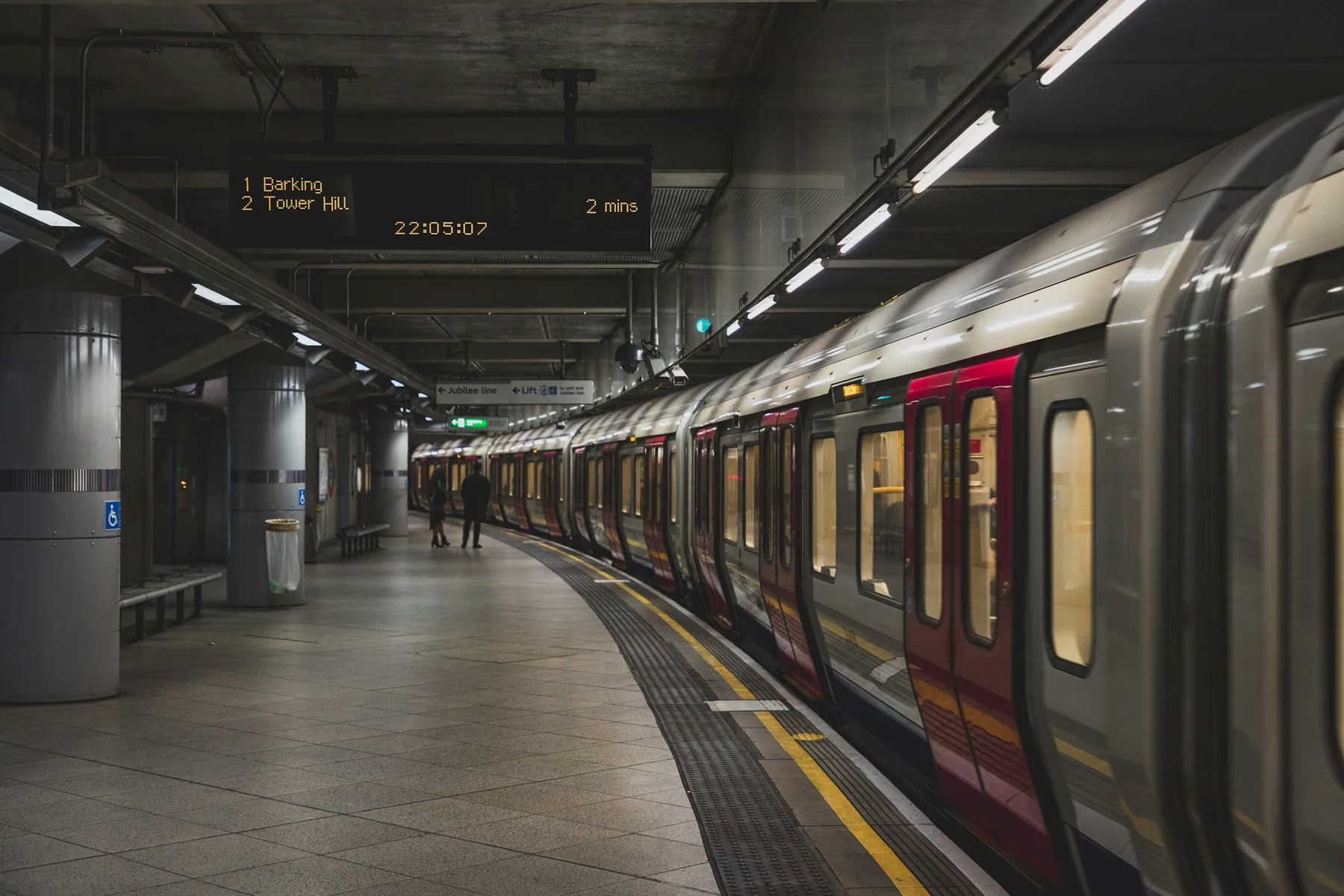
Some London Tube drivers in the RMT union have called a series of strikes from November 2026 to February 2027, over proposals for a new four-day working week. The first one starts at midday on Thursday 26 November.
First, don’t panic, especially if you’re visiting London. About 4 in 10 Tube strikes announced since 2022 were called off, often at the last minute. This one doesn’t shut the whole Tube (TfL expects most services to run), and everything else TfL runs carries on as normal. With a bit of planning, a strike day can cost you no more than a normal one, and it can even be a good excuse to see London from the top deck of a bus.
All Tube strike dates, November 2026 to February 2027
Each strike runs from 12:00 on the first day to 11:59 the next day, but the disruption lasts longer: services start winding down from about 10am on the first day and are only back to normal from about 6pm on the second.
| Strike starts (12:00) | Strike ends (11:59) |
|---|---|
| Thursday 26 November 2026 | Friday 27 November 2026 |
| Thursday 17 December 2026 | Friday 18 December 2026 |
| Saturday 19 December 2026 | Sunday 20 December 2026 |
| Monday 4 January 2027 | Tuesday 5 January 2027 |
| Wednesday 6 January 2027 | Thursday 7 January 2027 |
| Wednesday 17 February 2027 | Thursday 18 February 2027 |
| Tuesday 23 February 2027 | Wednesday 24 February 2027 |
| Thursday 25 February 2027 | Friday 26 February 2027 |
Check TfL’s strikes page the evening before you travel. We update this page when dates change.
Will the strike go ahead? About 4 in 10 are called off
Announced strike dates are a negotiating tool, and talks usually carry on right up to the deadline. We looked at every network-wide Tube strike announced since 2022 (leaving out small strikes by single teams such as engineers):
| Planned strike | What happened |
|---|---|
| 1 and 3 March 2022 | Went ahead |
| 6 June 2022 | Went ahead |
| 21 June 2022 | Went ahead |
| 19 August 2022 | Went ahead |
| 10 November 2022 | Went ahead |
| 15 March 2023 | Went ahead |
| 23 to 28 July 2023 | Called off on 21 July, two days before |
| Week from 8 January 2024 | Called off on 7 January, the day before |
| RMT, from 1 November 2024 | Called off on 1 November, the same day |
| Aslef, 7 and 12 November 2024 | Called off after an improved offer |
| September 2025 | Went ahead, and shut most of the Tube for several days |
| March 2026 | Called off (RMT suspended it during talks) |
| May 2026 | Called off |
| 2 and 4 June 2026 | Went ahead, with no Circle or Piccadilly line |
| 26 and 27 November 2026 | Talks on 24 November |
So it’s worth planning for a strike, but there’s a real chance some of the 2026 to 2027 dates won’t happen. This dispute is also narrower than the big ones of 2022 and 2025: only RMT drivers are involved (Aslef, the other drivers’ union, isn’t striking), so TfL expects most Tube services to keep running.
Our advice: plan a backup route, but don’t cancel a trip to London over it. Check TfL’s strikes page or the TfL Go app the evening before for the latest.
What runs on a strike day
First day (for example Thursday 26 November)
- Normal service on most lines until about 10:00, then services start to reduce.
- From midday: disruption on all lines, and no Waterloo & City line.
- No Circle or Piccadilly line all day.
- After 21:00: no Tube service expected. Plan your way home from an evening out before you go.
Second day (for example Friday 27 November)
- Tube services start from about 07:00, later than usual.
- Until midday: disruption on all lines, and still no Circle, Piccadilly or Waterloo & City line.
- From midday the network slowly recovers, with a normal service from about 18:00.
Running as normal on both days: the Elizabeth line, DLR, London Overground, buses and trams. They will be busier than usual, so allow extra time, especially at rush hour.
Staying on the Piccadilly line? Your nearest open station
Many visitors stay near the Piccadilly line, which won’t run on strike days. Here’s the nearest alternative from the stations people ask about most. Walking times vary, so check TfL Go or the journey planner.
| Piccadilly line station | What to use instead |
|---|---|
| Heathrow airport | Elizabeth line (see below) |
| Earl’s Court, Gloucester Road, South Kensington | District line from the same station |
| Knightsbridge (Harrods) | Bus, or walk to South Kensington or Sloane Square for the District line |
| Hyde Park Corner, Green Park | Victoria and Jubilee lines at Green Park |
| Piccadilly Circus | Bakerloo line at the same station |
| Leicester Square | Northern line at the same station |
| Covent Garden | Walk to Leicester Square for the Northern line |
| Holborn | Central line at the same station |
| Russell Square | Walk to Holborn (Central line) or King’s Cross |
| King’s Cross St Pancras | Northern, Victoria, Metropolitan and Hammersmith & City lines, Thameslink |
| Finsbury Park | Victoria line, or trains to King’s Cross |
| Hammersmith | District and Hammersmith & City lines |
The cheapest ways round London during a Tube strike
- Walk first if you can. On strike days buses fill up fast at rush hour, and a full bus may drive past your stop or only let a few people on. It’s frustrating and it’s down to luck, so if your trip is walkable, or another option works, take it.
- Take the bus with the Hopper fare. One bus fare is £1.85, and the Hopper fare lets you change to more buses or trams within one hour for no extra charge. However many buses you take, you never pay more than £5.55 a day on buses and trams. Use the same card or phone all day so the cap works. Outside rush hour, buses are much easier.
- Use the Elizabeth line for east to west trips. It crosses central London from Paddington through Bond Street, Tottenham Court Road, Farringdon and Liverpool Street to Whitechapel, and it isn’t on strike. Normal Tube fares and caps apply.
- Hire a Santander Cycle, early. A Day Pass costs from £3.50 and covers unlimited rides of up to 60 minutes each for 24 hours. Dock the bike before the hour is up and start a new ride to avoid extra charges. A single ride is £1.65 for up to 30 minutes. E-bikes cost more. Everyone has the same idea on strike days: the busiest day in the scheme’s history was a Tube strike day, 9 July 2015, with 73,094 hires. Docks near big stations empty early, so get a bike before 8am or check the app for free bikes and spaces.
- Walk the short hops. In central London many stations are close together above ground, so between neighbouring stations walking is often as fast as waiting for a crowded train. TfL’s journey planner shows walking routes too.
- Travel outside the busiest times. If you can, leave before 10am on the first day, or after 6pm on the second day, when the Tube is back to normal.
- Move plans to another day. Free museums, markets and walks will still be there tomorrow. If a day out depends on the Circle or Piccadilly line, it’s worth swapping the date.
Smarter strike-day tips for visitors and Londoners
- Do your Tube trips in the morning. On the first strike day the Tube runs normally until about 10am. Get across town early, then spend the afternoon somewhere walkable.
- Losing the Circle line matters less than it sounds. Nearly every Circle line station is also served by the District, Hammersmith & City or Metropolitan line. Those may be disrupted too, so check TfL Go before you set off.
- Use National Rail trains inside London. Overground and Elizabeth line aside, ordinary trains such as Thameslink and Southeastern aren’t part of this Tube strike. Contactless works on them within London’s zones and counts towards your daily cap. Thameslink, for example, links St Pancras, Farringdon, Blackfriars and London Bridge.
- Turn the bus ride into sightseeing. Some London bus routes pass more landmarks than a tour bus, for the price of one Hopper fare. See our best bus routes for sightseeing.
- Stay in one neighbourhood. A strike afternoon is a good time to explore one area on foot rather than crossing London. Try one of our free self-guided walks.
- Take the river. The Uber Boat by Thames Clippers river bus isn’t run by Tube drivers, so it’s unaffected. It costs more than the bus, but it’s a scenic way along the Thames between Westminster, the South Bank, the City and Greenwich.
- Travelling with children? Under-11s travel free on buses and trams at any time. Children aged 11 to 15 with an 11-15 Zip Oyster photocard also ride buses free, and get half price on the Uber Boat river bus. So a family that switches to buses pays only for the adults.
- Need step-free travel? London buses are low-floor with a wheelchair space, and Elizabeth line stations are step-free, so if you already avoid the Tube, a strike day changes little. Expect fuller buses at rush hour, though.
- Work from home if you can on the second morning, when the Tube starts late and the buses are at their busiest.
- Book a taxi or minicab early if you need one after 9pm on the first strike day, when there’s no Tube. Prices on ride apps tend to rise when demand jumps.
Getting to Heathrow during a Tube strike
The Piccadilly line won’t run on strike days, so don’t count on it for Heathrow. The Elizabeth line still runs to Heathrow Terminals 2 and 3, Terminal 4 and Terminal 5, and is usually cheaper than the Heathrow Express. Allow extra time, as it will be busier than usual.
Fare caps and refunds on strike days
- Daily and weekly caps still apply on strike days, whatever mix of Tube, bus, Elizabeth line and Overground you use. See our guide to London travel caps or try the TfL fare-cap calculator.
- Don’t count on a delay refund. TfL’s delay refunds have historically excluded delays caused by strikes, which it treats as outside its control.
- But claim if you were charged a maximum fare. If a station closed and you couldn’t touch out, you may have been charged the maximum fare. You can claim an incomplete journey refund up to 8 weeks after the journey. Wait 48 hours first, as most are fixed automatically.
Questions
When is the next Tube strike in London?
Will the Tube strike be called off?
I'm visiting London. Should I change my plans?
Which Tube lines are closed during the strike?
Are buses and the Elizabeth line affected?
Is the Overground on strike?
What's the cheapest way to get around during a Tube strike?
Sources and last check
Checked on 24 November 2026 on TfL’s website: strike dates and impact, TfL press release of 23 November 2026, bus and tram fares, Santander Cycles prices and refunds. Past call-offs as reported by ITV News: July 2023, January 2024 and November 2024. Other 2026 strikes: Strike Calendar’s RMT dispute log and Imperial College Healthcare NHS Trust on the June 2026 strikes. Santander Cycles record: TfL press release, March 2021. Child fares: TfL Visitor Oyster and 11-15 Zip Oyster. Strike plans can change at short notice, so check TfL before you travel.