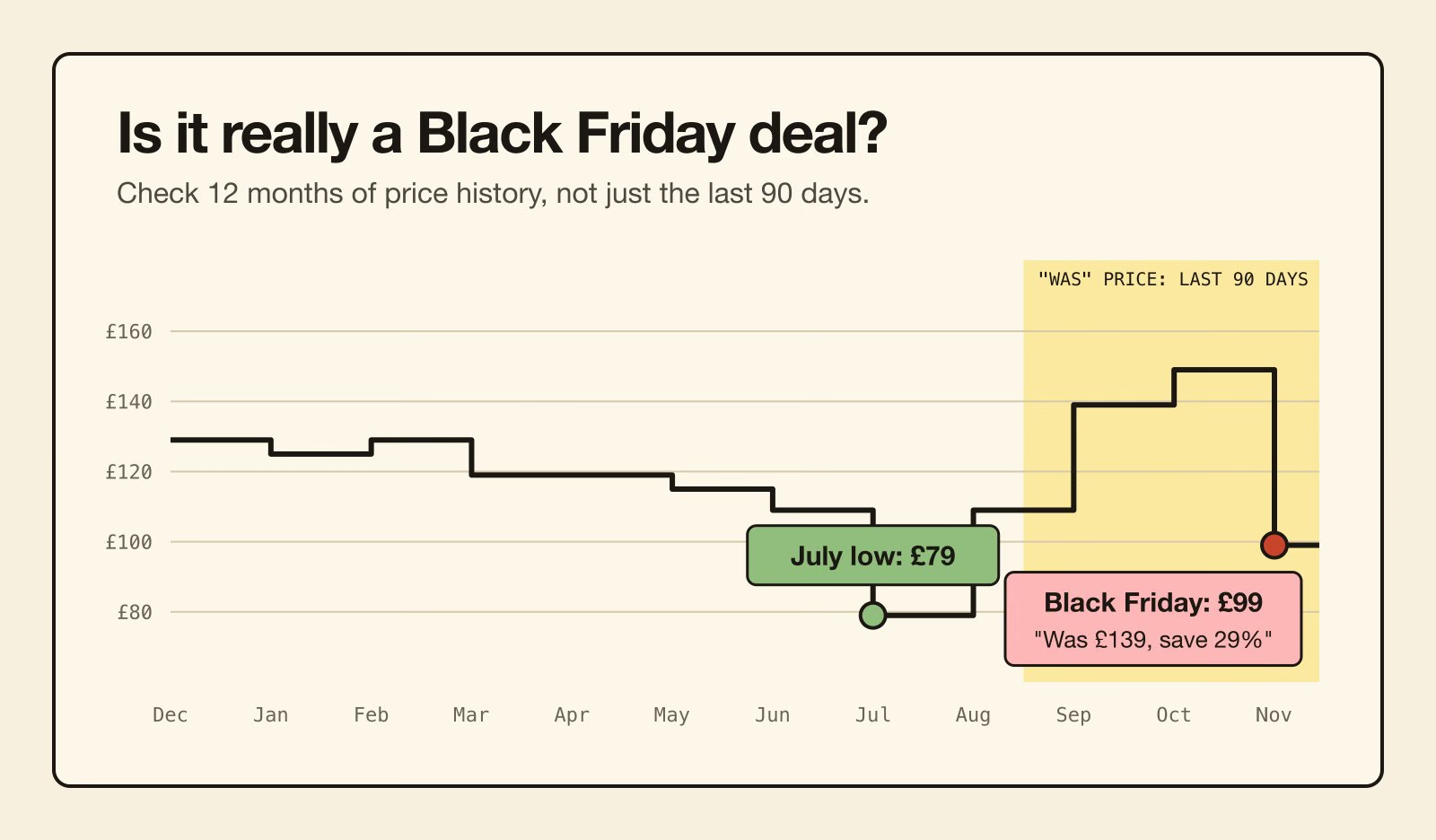
Amazon’s Black Friday Week runs from 19 to 30 November 2026, and the site will be full of red badges and crossed-out prices. Some are genuine. Many are not: when Which? tracked Amazon’s 2024 Black Friday deals, 88% were the same price or cheaper at another point in the six months before or after.
The good news is that checking takes about a minute per product, and there are a couple of easy ways to get a little money back on what you do buy.
The one-minute checklist before you click Buy
How to get the offer
- Ignore the badge.
“Black Friday deal” or “Limited time deal” says nothing about whether the price is low.
- Check the lowest price in the last 12 months.
Not just the last few weeks. A free price tracker shows it in seconds (see below).
- Compare one other shop.
Argos, Currys and John Lewis all run Black Friday sales too. Our Black Friday London page lists the ones we checked.
- Check who sells it.
“Sold by Amazon” and “Sold by” a marketplace seller can mean different returns and delivery.
- Add cashback before you pay.
It is small on Amazon, but it costs nothing (see the cashback section).
What Amazon’s “Was” price really means
The crossed-out “Was” price (Amazon also calls it the Typical Price) is the median price customers paid on Amazon over the last 90 days, leaving out prices from limited-time deals. Since May 2026, if a product spent most of those 90 days below that figure, Amazon includes the promotional prices too, which should make inflated “Was” prices rarer.
Even so, a 90-day window has two blind spots:
- It can’t see further back. If the product was cheaper on Prime Day in July or during October’s Big Deal Days, the “Was” price won’t tell you.
- A recent price rise counts. If the price crept up in September and October, the median rises with it, and the Black Friday “saving” looks bigger than it is.
An RRP or “List price” is different again: it is a recommended price, not what anyone actually paid on Amazon. Treat any saving measured against RRP with extra caution.
How to find the price history of an Amazon product (free)
The single most useful habit: look at the lowest price in the past year, not the past three months.
- CamelCamelCamel: paste an Amazon UK link to see the price chart, and set a free email alert for the price you’re willing to pay.
- Keepa: a free Amazon price tracker extension that adds a price-history chart directly under each product page.
- PriceSpy: compares the same product across UK shops, with its own price history.
How to read the chart:
| What you see | What to do |
|---|---|
| Black Friday price is the lowest in 12 months | A genuine deal: buy if you need it |
| Same as the price on Prime Day or in October | Fine, but not special: no rush |
| It was cheaper earlier in the year | Skip it and set a price alert |
| The price jumped up in the weeks before | The “saving” is mostly the jump: skip it |
Five traps to watch for
- Vouchers you have to tick. Some prices only apply if you tick a “Save £X with voucher” box on the product page. The price in search results may already assume it.
- Lightning deals with a countdown. The timer and “% claimed” bar are designed to rush you. If the 12-month chart says it’s a normal price, the timer doesn’t matter.
- Prime-only prices. Some deals need Prime. A 30-day free trial works if you’re new, but cancel before it renews if you don’t want to pay for it.
- A different model. Black Friday bundles and TVs are sometimes special model numbers that are hard to compare. Check the exact model number elsewhere.
- Delivery and minimum basket. Without Prime, standard free delivery needs a minimum basket. Check the total at checkout, not the product price.
Need a small extra to reach a basket? Our Amazon 5% multi-buy trick explains when four cheap items unlock 5% off.
Returns over Christmas
For the 2026 holiday season, Amazon is reported to accept most items bought between 1 November and 31 December back until 31 January 2027. It applies to items sold by Amazon; marketplace sellers can set their own rules, and some categories have shorter windows. Check the return date on your order page before you rely on it, especially for presents.
Separately, UK law gives you 14 days to cancel most online orders after delivery, whatever the shop’s own policy.
Get cashback on Amazon (and a £25 bonus elsewhere)
Amazon pays very little cashback compared with other shops, but there are still two easy wins.
Rakuten: £1 per Amazon order
Rakuten currently pays a flat £1 cashback per Amazon order, for up to five orders. To make it track:
- start from the Rakuten website or its browser extension on a computer, then click through to Amazon;
- orders placed in the Amazon app don’t track;
- check the Amazon offer and its current limits in your Rakuten account before you shop.
It’s small, but it’s free money on orders you were making anyway.
The £25 Rakuten bonus: spend £50 at other shops
New members who join through a referral get £25 back after spending £50 (excluding VAT) within 90 days. The important catch: Amazon orders don’t count towards the £50, and neither do gift cards.
So the smart way to use it this Black Friday:
- buy what’s genuinely cheapest on Amazon, with the £1 per order;
- buy anything else you need, such as a present, a gadget from Currys or beauty from Lookfantastic, through Rakuten, where you get the store’s Black Friday price, the shop’s cashback rate and, once you pass £50, the £25 bonus.
Zilch: Rewards when you pay
Zilch Pay now earns Rewards at thousands of shops, Amazon included. The rate is shown live in the app before you pay, and new members can get a referral bonus too.
Amazon Black Friday questions
How long does Amazon Black Friday last?
When is Amazon Black Friday 2026?
How do I see the price history of an Amazon product?
Are Amazon Black Friday deals actually good?
What does the 'Was' price mean on Amazon UK?
Can you get cashback on Amazon UK?
Do Amazon orders count for the Rakuten £25 bonus?
How long do I have to return Amazon Black Friday purchases?
Sources and last check
Checked on 20 November 2026 against Amazon’s Black Friday page, Amazon’s explanation of how it shows genuine deals, Which?’s Black Friday price research, reports on Amazon’s 2026 reference-price change and holiday returns window, and Rakuten’s referral terms. Prices, offers and terms change, so check before you buy.